

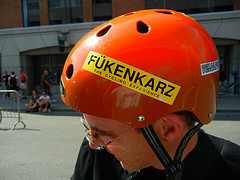
 I’ve received requests to tackle the bicycle helmet debate ‘Opponents go head to head on the helmet,’ which appeared in the August 25-31 issue of West Ender. Vancouver resident Ron van der Eeden has mounted a court challenge against the validity of bicycle helmet laws in British Columbia under Canada’s Charter of Rights and Freedoms. He argues, ‘Bicycle helmet legislation is discriminatory as it applies, with demonstrable justification, only to individuals who ride bicycles without being equally applied to individuals who drive automobiles or walk.’
Although Kits readers disagree about B.C.’s bicycle helmet law, everyone agrees that the WE article was a shallow stab at probing a real issue. So let’s take a better look at both sides of the bicycle helmet debate here by hearing everyone’s thoughts.
Note: Before we proceed, I’d better ‘fess up: I’m a cyclist who wears a helmet. The list below reflects comments I have received—some contradictory—not my personal opinion. A lot of people have expanded Ron van der Eeden’s attempt at explaining why helmets may not enhance safety. The pro-helmet gang’s response was concise. Add any point that’s missing by commenting. Here’s what I’ve heard from you all so far:
Why cyclists object to mandatory helmets (Section 184 of the B.C. Motor Vehicle Act)
1) A helmet does nothing to prevent a cyclist from getting hit by a car or reduce accidents.
2) The effectiveness of helmets in preventing injury is seriously exaggerated.
3) Equating helmets with bicycling safety is misleading. The primary emphasis should be on safe riding skills and good driving habits–so that drivers see cyclists.
4) The Walker Study: Ian Walker, a psychologist at the University of Bath who rides his bike to work every day, rigged his bike with an ultrasonic sensor that could detect how close each car was that passed him. He rode with and without a helmet until 2,500 cars passed him. When he was wearing a helmet, cars passed 8.5 centimeters (3.35 inches) closer than when his head was bare. Why? Walker theorizes that helmets change the behavior of drivers.
5) Helmets decrease peripheral vision for cyclists.
6) The Dare Devil Effect: The opposite of the Walker Study. Helmets are compared to anti-lock brakes, not safety belts as is commonly assumed. A safety belt unequivocally prevents injury in accidents. However studies show that anti-lock brakes, which were designed to reduce accidents, resulted in faster driving—i.e. cyclists who wear helmets take more risks.
7) Helmets deter people from cycling.
Why cyclist should wear helmets
1) Helmets help prevent serious head injuries and loss of life in accidents. The highest cause of death in a motor vehicle collision accident is a serious head injury.
2) It’s against the law not to wear a helmet.
What are your thoughts as a cyclist or driver? Should cyclists be forced to wear helmets? Is the bicycle helmet debate old? Should we focus on topics like safe riding technique, sharing the road and texting while driving?

Last modified: August 31, 2011


I cycle to work every day rain or shine. I think the helmet law makes sense especially in a country with free health care. If you choose not to wear a helmet and hurt your head perhaps the hospital should choose to charge you for care.
1) This is both obvious and irrelevant, helmets don’t make you invincible they reduce the risk of turning your brain to mush. You only have ONE brain and it’s hard to fix, look after it.
2) See answer to 1.
3) See answer to 1.
4) I also drive a lot and I don’t think I’ve ever noticed whether a cyclist has ahelmet on or not. One study with a sample size of one cyclist is not very compelling evidence. There was also no control for how his behaviour changed when cycleing with/without a helmet
5) Seriously??? I’ve never come across a helmet that reduces my vision
6) See answer to 1. This is trotted out a lot when people talk about safety equipment but nobody has ever proved it. Most people know when they fall off their bike its going to hurt and a helmet only protects your head. Point 6 also contradicts points 1 & 2
7) Maybe but I doubt this puts off more than a tiny percentage of people
Falling off a bike and hearing the impact sound of my helmet against the pavement – that’s enough to keep me wearing my helmet on every bike ride I take (3-4 times a week). Yes – I crash replaced that helmet!
Helmets don’t prevent injuries in general – they prevent brain injuries. The kind that costs health care millions of dollars. Broken arms heal, broken brains do not.
I have to admit – I’m a cyclist who follows rules diligently. My biggest frustration with cycling is other cyclist blowing through stop signs, red lights etc.. I have never had troubles with aggressive drivers, only aggressive cyclists….
I’m not a fan of helmets,never was and never will be. I don’t think that they should be mandatory IF YOU ride of a bike path. If you go on the road, then your chance of collisions with a car increases. I would love to see Vancouver becoming more like Amsterdam and be rid of the helmet, but that won’t happen until the population of this city increases dramatically, more bike lanes are put in place, affordable public transportation is brought in and people leave their cars at home or just ditch them.
Until I see more cars on the road then bikes, I’ll keep riding with my helmet on. I just feel safer that way.
Don’t forget to take into account bicycle technology in the Dare Devil Effect. Modern carbon fiber road bikes and full suspension mountain bikes have permitted riders to go far faster and ride more dangerous terrain than was possible in the 1990s.
Health care is not free in this country. Every single taxpayer contributes to supporting health care and many health related requirements are not covered by our MSP plans. If you have a serious brain injury from an accident you will discover (or your loved ones will) just what is and isn’t covered. You will be less blase once you get the facts.
When the helmet laws first came in I was disappointed but did and do comply. When a car ran a stop sign through the 8th avenue cycle route one morning I was more than a little happy for that helmet. My head hit her windshield hard enough to shatter it, then my head hit the pavement. I did have to replace my helmet but my brain was fine. I had to attend a lot of physio etc. For a year after for the damage to other body parts but I will always be grateful that I did not sustain brain damage.
I do understand why some people challenge the helmet laws, I really do, but if you don’t believe a brain injury is one of the worst things that can happen to you, or you don’t think it will happen to you, at least take the time to find out what really happens to people who experience this. It might make you reluctantly change your feelng about it.
The driver who blew through that stop sign, admitted that she knew there was a stop sign for the direction she was going, knew there were cyclists in the intersection, knew it was a marked cycling route-but decided to speed through the stop sign because *she* was in a hurry. There are other drivers out there just like that. In the space of two months that same year four people I know were hit on cycling routes by drivers who admitted they were “in a hurry”.
Both drivers and cyclists take risks regularly, but each and every one of us is responsible not just for our own safety but for that of the people around us. It isn’t a cyclist vs driver issue-it is a human being as part of a commnity issue and being caring and considerate of others. If you want to take chances or try some dare devil moves on your bike there are plenty of trails around to do that and they are better than trying it on a car filled street.
should motorcyclists have to wear helmets?
I love how people think if they ride on bike paths there is no way their head could ever possibly make impact with something damaging.
A helmet is such a minor inconvenience, I just cannot understand the rage involved with wearing one. I’ve seen a traumatic brain injury completely transform a close friend’s life, however, and if there is anything in the slightest I can do to avoid a similar fate (ie not being able to independently care for myself EVER again), I would do it.
Wow, for someone to use the logic of “if automobilists and pedestrians don’t have to wear a helmet so why should I?” is a steaming load of self-serving nonsense.
I dare anyone who questions the logic of wearing a helmet to watch any number of documentaries on brain injuries received by not wearing a helmet through either cycling, motorcycling or even skateboarding and I guarantee you that only a delusional person would negate the logic of a helmet.
To see survivors of head injuries living half-lives, often in institutions, with physical and mental damage that leaves them with diminished cognitive functions,as well as changed personalities, is heartbreaking.
The saddest part? The families who are left to pick up the pieces and deal with a loved one who is a different person but who is often dimly aware that there is something very wrong but unable to figure out what it is.
The reason I am so passionate about this? I had a good friend who was a top functioning professional who while cycling on vacation hit a bump pitched over the front of her bike (without a helmet) and woke up 2 months later. Her personality was changed and although able to live on her own has never been able to hold a full time job or be the same person she once was.
For all of us who cycle and have the gift of living in a city that has become so bike friendly (on a year-round basis) it really is not a big deal to have your hair messed up or not have the cool look that you think you need.
I’m a big believer in Darwin but there are too many taxpayers and family who have to pick up the pieces for someone who didn’t feel like wearing a helmet.
I have also had 2 close friends in bicycle accidents. One was on a roadway, NOT wearing a helmet (it was before the law was introduced), and it changed his life permanently from the brain damage. He was in a coma for months, and it took him years to return home from extended care/rehab. The other was on a bike path, wearing a helmet, and she “only” suffered a concussion. I hesitate to think what the outcome would have been if she had not been wearing the helmet.
As a motorcyclist, I would never consider NOT wearing a helmet (even when the law for that was repealed briefly years ago).
As a side note, I had to shake my head the other day, seeing a bicyclist along 10th Avenue riding in his Tilley hat and talking on a cellphone. I can only wonder if he is one of the people complaining about car drivers not paying attention, when he is carrying on like that.
It is better to wear a helmet than to not.
The other side of the argument, though, is that it is better to bike than to drive. Despite the risk of injury, bikers live longer and cost the health care system less than drivers. Drivers are also at risk for injuries, but they are also much more likely to suffer from heart disease and obesity than bikers. One has to ask what is the greater public health menace: bicycling head injuries, or obesity? (the correct answer is obesity.) How many people with anecdotes about biking head injuries also know someone who died too early of heart disease? If helmets do deter people from biking, helmet laws can cost the health care system MORE money than head injuries would. Think of getting people onto bikes as an important public health intervention.
Helmets deter people from biking by being unfashionable, making biking appear less safe than it is to new bikers, making bikers heads hot, and giving them a bulky object which they must babysit all day. They also prevent bike sharing programs like Montreal’s Bixis, where people can pick up a bike from a rack for a small charge if they get tired of walking somewhere. Vancouver requiring people to plan their bike trips in advance by requiring they bring their helmet deters people from the spontaneity of picking up a Bixi for a short trip.
All that said, I wear a helmet and encourage others too. It’s a little important. But, its importance is greatly exaggerated. Requiring helmets feels like the right thing to do, but it is not justified when you look critically at the evidence.
Thanks for addressing this issue.
What I find frustrating about the entire debate is that people are coming at it from two different perpectives, or at least I do:
1) Should you wear a helmet when cycling?
and
2) Should we be penalized for not doing so?
My answer to the first is – yeah, I think so – if they claim to care about their wellbeing and ride at speeds that exceed 10k/hour and ride in traffic. But ultimately I believe it should be an individual’s choice. Quoting Voltaire:
“I disagree with what you say, but I will defend to the death your right to say it.”
My answer to #2 is HELL NO. It’s just a cash grab. It’s like making the act of dropping a hammer on your toe ILLEGAL, with the reasoning that it could seriously hurt your foot and it could be avoided if you wore protective footwear. Ofcourse, this helmet law is only one of many ridiculous forms of legislation (ie. War on Drugs)
drivers have to wear seatbelts, cyclists have to wear helmets.
I have been biking to work in Europe for 10+ years – and never wore a helmet. When I moved here I have been harassed into to wearing one. I have been stopped by the police 4 times – and got written a ticket twice.
So now I wear a helmet.
Everyday I bike into my office, with a helmet, I am in real danger or close danger to being hit by a driver who forgets to shoulder check in the bike line before making a right turn – or being hit by drivers coming out of parking lots who are only car watching.
This is the real danger for bikers. I have not never ever seen a driver being pulled over for neglectful shoulder-checking or forgetting to look for bikers. Not to mention all the drivers who are talking on mobile phones while rolling down the streets.
It might be a good thing that I gave up and starting wearing a helmet. I am just looking for some action being taken to increase driver’s awareness – the problem of bike safety cannot not be reduced to wearing an extremely inconvenient plastic hat or not.
Not wearing a bike helmet gives new meaning to “a no-brainer”!
As to this being a cash grab scenario? You bet it will be. The city bean-counters will not miss an opportunity to make up the deficit while enforcing safety.
I think wearing a helmet should be a choice, but mandatory for anyone younger than 16. Helmets should certainly be non-mandatory on bike paths, the seawall and park trails. I find a helmet does hinder visibility, but choose to wear one in downtown Vancouver simply because I know car drivers often don’t see cyclists (and I was fined, which was humiliating). I will always prefer people to have a choice and not be subject to fines by authorities, which can really ruin your day and take the fun out of life. I also find the cost of most helmets too high. A hundred bucks for a piece of plastic with foam…give me a break. I wear the cheapest $15 helmet when on the street and risk the $126 fine when cycling on the seawall because I want to look good and feel fine and not be dressed up like some kamikaze pilot. I vote for HELMETS BY CHOICE.
The government needs to change the law, no coverage for head injuries if cyclists aren’t wearing a helmet, other body parts remain covered. No coverage for anybody in a car accident that didn’t wear a seatbelt. After a few horror stories and media frenzy people will comply, if not, then that’s just weeding out the shallow end of the gene pool.
As a life long cyclist who started to wear a helmet far before it was popular to do so, and who also has done a far bit of research on the topic, I’ll say the 2 reasons given to wear a helmet are very weak.
Reason number 1 has never been shown to be true and for good reason. Bicycle helmets are made for simple falls, and simple falls almost never result in serious injury or death. They can of course, but that situation can (and does) just as likely occur to people on foot as on a bicycle.
When serious injury or death does occur to cyclists, even when the cause of death is listed as a head injury, there are almost always other injuries that cause death as well. As well, in these collisions the forces involved are almost always beyond the specified limits of protection a helmet is made to provide.
Cyclists with helmets on die just as readily as cyclists without helmets on, this is a reality that must be recognized, but that’s not to say it shouldn’t be noted that cyclists (even cyclists that do not wear helmets), on average, live longer lives than average. Far from risking life by not wearing helmets, cyclists survive as healthy individuals, just so long as they can avoid collisions with motor vehicles.
After adding my two bits to this discussion on Sept. 9, I was hit by a car on Sept. 16 at 7:20pm while riding my bike along 8th Ave. West (a cycle route!) just before reaching MacDonald. The driver did not see me at all even though I had my lights on. Despite my earlier disagreement with the current helmet law, I WAS wearing my helmet. So, does this accident change anything for me? Hmm. Let’s see. I went flying over the hood of a car that made a totally unsignalled U-turn. I landed on the pavement, spraining both my ankles, bruising both legs, taking the skin off my knuckles, possibly breaking a finger and totally throwing my spine out of whack, with the long term consequences still to be assessed. At least I didn’t hit my head! Should helmets be mandatory. HELL YES. Helmets should be mandatory on the streets of Vancouver. WHY? Because the drivers of cars just don’t see us, no matter how much reflective clothing, no matter how bright our lights, no matter how loud our bells. And believe me now, I feel lucky to be alive.
PS On the other hand, I still think helmets should be optional for the sea wall as it’s cars that present the danger to cyclists.
The REAL issue with most (including myself) who don’t want to wear a helmet(and in fact won’t ride after the filth harassed me about it) is the issue of the state/government telling us how to live/die. It doesn’t directly effect anyone else so #$%$# them, we shouldn’t have to…
So lets say you disagree… Where does it stop.. Some studies suggest saturated fats cause heart disease.. Why not ban x-fatty foods or tax them to reduce cost on healthcare system. What if eating a diet of wheat grass and tofu and nothing else will eliminate 50% of health problems.. The state then can regulate your diet/exercise/etc. Sure they might not yet have the means to enforce that, but the argument is the SAME.
P.S. look up issues brought up in the ‘fat head’ movie/documentary, they are ‘real issues’ there is very little evidence that saturated fats etc. cause heart disease, and in-fact evidence suggests vegetable oils are the cause.. Yet Europe is exploring saturated fat tax as we speak. Bureaucracy making more of itself to justify itself.
Two camps “I want the state to look after me and/or all of us” “I want to look after myself”…
Reduced safety in numbers is another reason why helmet laws don’t work. Forcing cycling to wear helmets has been shown to reduce cycling by about a third. When there are fewer cyclists on the roads, vehicle drivers forget to look out for cyclists so riding a bike becomes more dangerous.
Research shows that the increased risk of accidents following helmet laws outweighs any possible benefits of helmets https://www.ncbi.nlm.nih.gov/pmc/articles/PMC1410838/
It’s really sad that so many people mistakenly justify helmet laws in the incorrect belief that they reduce healthcare costs.
I hope a few more people will look at the research and base their arguments on facts – that helmet laws increase healthcare costs so should be repealed.
If you are under 18 years of age you should have to wear a bicycle helmet but if you are 18 and older you should be old enough to decide for yourself.
I am a Kitsilano lawyer, who practices in personal injury law, and sees lots of tragic injuries. While some of the statistics raised by the no-helmet campaign are interesting, particularly the distance that drivers stay away from non-helmeted bikers, there is nothing that can bring people back from injury, particularly brain injuries. I have yet to have a client who would willingly trade any additional injury for money or principal, and I can’t imagine anyone who has suffered from a serious road injury, or has a family member that has done so, could possibly advocate not wearing helmets.
All of the arguments against helmets have simple responses 1) dissuading people from biking – increase reasons to bike such as bike lanes and infrastructure or decrease taxes on bikes, 2) distance from cars – again bike lanes, or wear one of those awesome helmets that looks like a hat.
In the end, though the anti-helmet argument is interesting, it is ultimately irresponsible.
Since when do governments have the right to make personal health choices for individuals? If this is the case then how come smoking is legal? Smoking causes infinitely more to our healthcare system than brain injuries from bicycling, not to mention pollution from cars and trucks. This law actually discourages people from riding bikes because they don’t want to be harassed by law enforcers, who certainly should have something better to do with our valuable tax dollars.
Riding a bike is easy. Paying attention to traffic is easy. A bike can avoid people and cars. It travels slower than traffic (usually) and stops quicker. I have ridden 50 years WITHOUT a helmet, no car accidents, some minor falls. Its real simple to stay safe, pay attention to the road, look out for traffic, don’t collide with things or let then collide with you. Wearing a helmet make biking seem dangerous. It isn’t. For every story of “my friend or I collided with…” there are 10,000 stories of “a car cut me off and I did not collide with it..” Like the Vancouver councillor said after he blew thru a stop sign and t-boned a car (didn’t see it ) ” wearing a helmet is a no-brainer” I agree, If you can’t be bothered to use your brain while riding a bike -you need a helmet. Me – I use my brain. My best protection is prevention. Maybe that Kits lawyer could tell us how many people could be saved wearing a helmet showering or working around the house?
^Love it Bob! Well said. I’ve been cycling daily for about 10 years now and I’ve never had any serious accidents that would have warranted wearing a helmet. But I occasionally put one on if I’m headed downtown and want to avoid getting ticketed. With the level of accidents/injuries that occur with car traffic it’s a wonder to me more people aren’t pro-helmet when it comes to driving – where’s the vocal outrage on that? Driving is actually dangerous.