

Computer modelling done at the time indicated that the reallocation of one or two lanes would interfere with transit service, slowing bus operations in both northbound and southbound directions, as well as adding to traffic congestion in Kitsilano and West End neighbourhoods. – Vancouver City report
The Vancouver’s Sun’s Miro Cernetig nails the upcoming Burrard Bridge experiment in today’s issue. Here are the highlights:
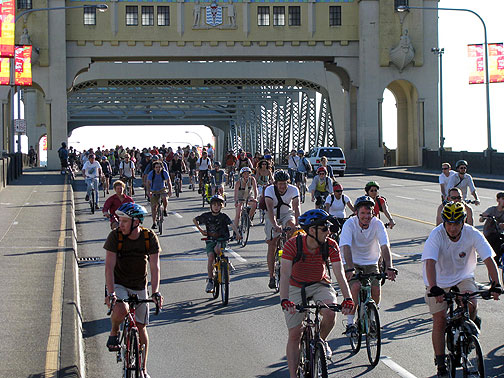 This $1.45-million experiment is doomed to failure. The introduction of bicycles to the busy bridge has been tried before, in 1996. It was deeply unpopular and a traffic disaster.
The reality is the Burrard Bridge experiment will have almost no impact on the city’s carbon footprint. His own staff have told me that in private. This is because reducing car lanes on the bridge will cause gridlock, forcing automobiles and buses to idle, creating more, not less, greenhouse-gas emissions. Rerouting cars to other roads in and out of downtown Vancouver will also add kilometres to a trip — which means more gas burned.
The other inescapable fact worth noting is there’s also no cycling crisis that needs solving. In fact, bicycling traffic on the Burrard Bridge has actually plateaued, as the city’s own report notes: “Growth of cycling and walking on the Burrard Bridge, which increased 30-40 per cent between 1996 and 2001, appears to have plateaued in recent years.”
If the mayor votes on closing lanes of the Burrard Bridge to cars he will in essence be telling us the desires of a few hundred cyclists — and that vociferous bicycling lobby that helped put him in office — are worthy of a $1.45-million expenditure the city’s own planners know is unlikely to be good value.
Until then, put fences up on the curbs to keep cyclists from falling into traffic. And tell them, please, to pedal a little slower on the sidewalks until they get the bridge of their dreams.

Last modified: May 7, 2009


I don’t think I’ve ever seen cyclists have issues on the bridge. Whether or not I am driving or walking.
If there was money, just build a new cyclist/pedestrian bridge 😉
What about counter-flowing the bridge so that there is 5 lanes for vehicle traffic and the 6th lane for cyclists. 3 lanes inbound in the morning, 3 lanes outbound in the evening for vehicles?
Then again the issue would be, how easy would it be for a north bound cyclist to get into a south bound lane if only one lane is used? Kind of interrupts their cycling flow if they have to cross the street to get into the cycling lane eh?
All I know is traffic on the bridge can get pretty heavy with 6 lanes. Remove a lane and there will be more slowdowns.
We could spend the $1.45-million to buy cars for the cyclists! 🙂
Once again I’d like to point out that in 35 years of using the bridge I’ve never had a problem.
To spend all this money for a couple hundred people to cycle on the road for a few minutes a day is absolute lunacy.
Want a snapshot of what daily conditions are like on the bridge?
Go to http://www.katkam.com and have a peek, see for yourself how thin cyclists are on the bridge.
Oops!
Make that http://www.katkam.ca/
Thanks for this post. I don’t even want to imagine my commute with a lane closure.
I’m an ardent cyclist, and I think lane closures for bikes on Burrard Bridge is an absolutely silly idea. The only purpose it serves is to grease the wheels of bureaucracy.
Yes, it’ll be gridlock. But remember the transportation plan for the Olympics involves reserving one lane EACH WAY for official Olympic vehicles. That takes us down to 4 lanes….a couple more off for cyclists (they use it so much in the winter anyway) and we’re left with a 2 laner. OUCH!
If there is no money for a bike bridge charge them a toll when crossing Burrard bridge and build the new bridge. On the new bridge introduce a toll as well as it usually happens for cars and trucks.
I love the Burrard Bridge bike lanes and hope they will be retained, enhanced even, once the current test is over. There has been a lot of squawking in the media by a handful of businesses who maintain that the changes have reduced the number of customers frequenting the area. Whether true or just the reflex actions of change-resistant business types is of little interest to me. What they should be doing is embracing the change, mounting bike-friendly events [discounts if you bike in, special delivery services for two-wheeled shoppers who spend over a certain amount, etc. ad nauseum]. Get creative guys. With all this whining going on I certainly can’t see myself patronizing these businesses. I dine at Kettle of Fish once in awhile and I visit Art Knapp’s every spring. This year I’ll hold my nose and buy my plants at one of the big box retailers since the little box retailers can’t seem to see outside of the box itself. In the case of Art Knapp’s, the opening of the Canada Line, Canadian Tire and Home Depot on Cambie Street are probably having a bigger impact on retail sales than any bike lanes could ever have.
Change is going to happen with or without them on board. What needs to be done is make hard choices and it’s heartening to see that the mayor and council are willing to make those choices rather than bowing to anachronistic interests. Thanks for pioneering a new way forward.
Wow! Reading this in January 2011 and it sure gives me a chuckle. The Burrard Bridge lanes have been an unqualified success. The beauty of the internet is the permanent record of this type of off the mark prediction. It will come in handy to counter the naysayers when additional cycling improvements are proposed.
This is pretty funny reading. Especially since over a million cycle trips were measured on the Burrard Bridge in the first year after the lane opened.
Thanks to the Kitsilano.ca web site for keeping this nonsense around.